
New Office Update
The DESSWO office location is now open!
We are now taking new patient visits!
Call us at (937) 356-9966
5250 Far Hills Avenue
Suite 150
Dayton, Ohio 45429
We are prepared to address various endocrinology disease states, including:
- Diabetes (Type 1, Type 2, Gestational)
- Thyroid Disorders
- Osteoporosis and Metabolic Bone Diseases
- Pituitary and Adrenal Disorders
Insurance Information: Insurance credentialing with major commercial and Medicare Advantage plans is currently underway or complete for many payers. We are now accepting patients with the following insurances:
- Medicare
- Medicaid
- Medical Mutual — Commercial and Medicare Advantage plans
- Humana — Medicare and Medicaid
- Anthem
- Cigna
- UnitedHealthcare / UMR — Commercial and Medicare Advantage plans
- CareSource — Medicaid, DSNP, MarketPlace, MyCare
- AmeriHealth
- Buckeye
- MediGold
- VACCN
Note: We are not currently contracted with Aetna, Aetna Better Health of Ohio, or Devoted. Credentialing for additional plans (e.g., Ohio Health Choice) is in process.
As of now appointments can be scheduled by calling the office at (937) 356-9966, Monday to Friday, 8am–4pm.
If your call is not answered, please leave a message, and we will respond within 1–2 business days.
About The Doctor
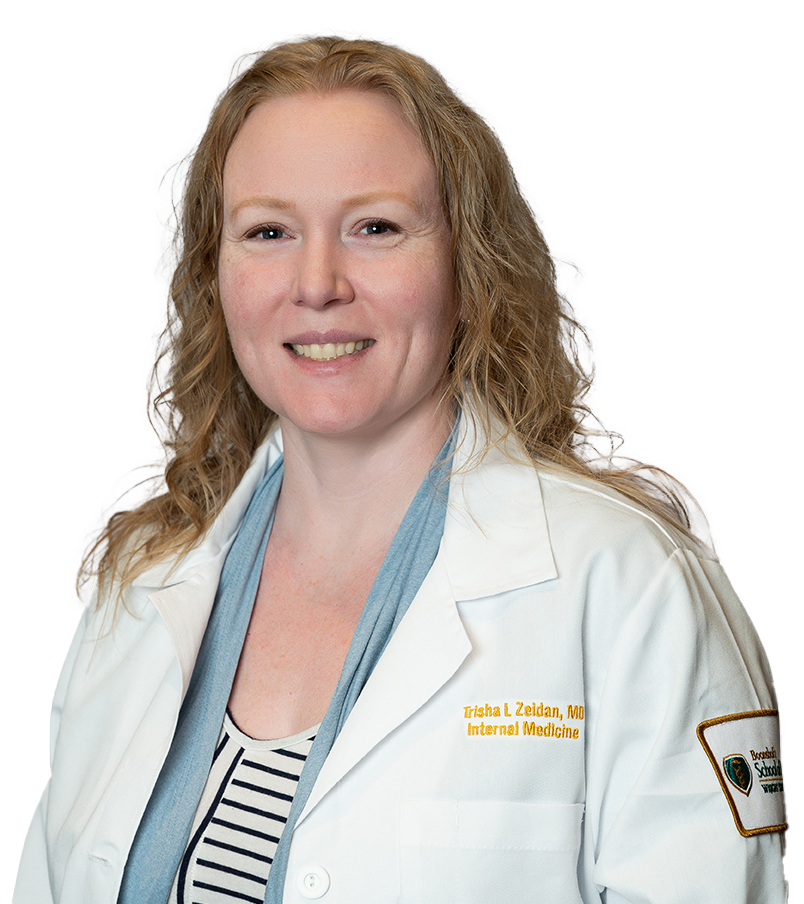
Trisha Zeidan, MD
I am an endocrinologist who has been practicing in the greater Dayton area since 2011. My top priority for success is the collaboration and communication between me and each individual who seeks my help. This collaboration fuels my particular passion for the treatment of diabetes mellitus. I enjoy working with individuals and supporting their management skills in treating such a complex condition. These skills may be related to lifestyle choices, weight loss, medication management, and the use of technology.
I also enjoy educating young doctors in Dayton’s many Family Medicine and Internal Medicine training programs. As an Assistant Professor of Internal Medicine at the Wright State University Boonshoft School of Medicine, I have the opportunity to participate in the education of medical students and residents.
I have served as a member of the advisory board for Diabetes Dayton, a local nonprofit organization whose entire mission is outreach to those with diabetes. This organization hosts Camp KoManShe, a summer camp for children with diabetes, for which I have served as medical director since 2021.
As a board-certified specialist in Endocrinology, Diabetes, and Metabolism, I treat adults for a variety of conditions, including:
Type 1 diabetes mellitus is an autoimmune condition where the immune system destroys the insulin-producing cells in the pancreas, resulting in little or no insulin production. This leads to high blood sugar levels, requiring lifelong insulin therapy through injections or a pump, along with regular monitoring and balanced lifestyle habits. It often appears suddenly in children or young adults and, while incurable, can be well managed to support a healthy, active life.
Type 2 diabetes mellitus is a chronic condition where the body becomes resistant to insulin or doesn't produce enough of it, causing high blood sugar levels over time. It develops gradually, often linked to factors like overweight, inactivity, and genetics, and is the most common form of diabetes (90-95% of cases), typically appearing in adults but increasingly in younger people. Symptoms include increased thirst, frequent urination, fatigue, and blurred vision, and while there's no cure, it can often be managed or even prevented with lifestyle changes, healthy eating, exercise, and medications if needed.
Managing an insulin infusion pump (also called continuous subcutaneous insulin infusion or CSII) involves delivering rapid-acting insulin continuously to mimic natural pancreatic function for better blood sugar control, especially in type 1 diabetes.
Key aspects of daily management include:
Basal insulin — A steady, low-level delivery 24/7 (often programmable for different rates throughout the day, or auto-adjusted in advanced/hybrid closed-loop pumps linked to a CGM).
- Bolus doses — Manual surges for meals (calculated via carb counting and insulin-to-carb ratio) or corrections for high blood sugar.
Infusion set care — Change the site (cannula and tubing) every 2–3 days to prevent infections, blockages, or poor absorption; rotate sites (abdomen, thighs, arms, buttocks) to avoid lipohypertrophy.
- Goiter: Enlarged thyroid gland, often from iodine deficiency or autoimmune issues; may cause neck swelling or swallowing problems.
Thyroid nodules: Lumps in the thyroid; usually benign, but some overproduce hormones or need checking for cancer via ultrasound/biopsy.
Hyperthyroidism: Overactive thyroid producing too much hormone; causes weight loss, fast heartbeat, anxiety, heat intolerance (common cause: Graves' disease).
Hypothyroidism: Underactive thyroid with too little hormone; leads to fatigue, weight gain, cold sensitivity, dry skin (most common cause: Hashimoto's).
Hyperparathyroidism: Overactive parathyroid glands → too much PTH → high blood calcium. Often from benign tumor; causes bone pain, kidney stones, fatigue.
Hypercalcemia: High blood calcium (usually from hyperparathyroidism). Symptoms: thirst, nausea, confusion, weakness.
Hypocalcemia: Low blood calcium (often from damaged parathyroids). Symptoms: tingling, muscle cramps, spasms.
Hyperparathyroidism: Overactive parathyroid glands produce excess PTH, raising blood calcium and pulling it from bones. Often due to a benign tumor; causes bone loss, kidney stones, fatigue.
Hypercalcemia: High blood calcium levels, usually from hyperparathyroidism. Symptoms: thirst, frequent urination, nausea, constipation, confusion, weakness.
Hypocalcemia: Low blood calcium, often from underactive parathyroids (e.g., post-surgery). Symptoms: tingling in lips/fingers, muscle cramps, spasms.
Osteoporosis and Osteopenia: Reduced bone density. Osteopenia = mild thinning; osteoporosis = severe, with high fracture risk. Can be worsened by hyperparathyroidism, aging, low calcium/vitamin D.
- Adrenal nodules: Lumps or growths in the adrenal glands; most are benign (noncancerous) adenomas and cause no symptoms. Some overproduce hormones, leading to high blood pressure, weight changes, or fatigue; often found incidentally on scans and monitored or removed if problematic.
- Cushing's syndrome: Condition from too much cortisol over time (hypercortisolism). Causes include adrenal tumors/nodules, pituitary issues, or long-term steroid use; symptoms: round face, upper body weight gain, thin arms/legs, stretch marks, high blood pressure, fatigue, easy bruising.
- Pituitary tumors: Mostly benign growths (adenomas); can press on nearby structures or overproduce hormones, causing vision issues, headaches, or hormone imbalances.
- Hyperprolactinemia: Excess prolactin hormone (often from prolactinoma tumor); causes irregular periods, infertility, breast milk production (in non-pregnant), low libido, or erectile issues.
- Diabetes insipidus (Arginine vasopressin deficiency): Low antidiuretic hormone (ADH/vasopressin) from posterior pituitary damage; leads to excessive thirst and large amounts of dilute urine (not related to blood sugar diabetes).
- Cushing's Disease: Pituitary tumor overproduces ACTH, causing high cortisol; symptoms include round face, weight gain (upper body), stretch marks, high blood pressure, fatigue.
- Growth Hormone Excess: Excess GH from tumor; in adults causes acromegaly (enlarged hands/feet/face, jaw changes); in kids causes gigantism (extreme height).
- Hypogonadism: Low sex hormones (from pituitary underproduction or tumor effects); causes low libido, infertility, erectile dysfunction, irregular periods, fatigue, reduced muscle/bone mass.
Polycystic ovary syndrome (PCOS) is a common hormonal disorder affecting women of reproductive age, caused by excess androgens (male hormones) and insulin resistance.
It leads to irregular or missed periods, infertility, excess facial/body hair (hirsutism), acne, weight gain, and small cysts on the ovaries (though cysts aren't always present or needed for diagnosis).
There's no cure, but it's manageable with lifestyle changes (diet/exercise/weight loss), medications (birth control for periods/hormones, metformin for insulin, anti-androgens for hair/acne), and fertility treatments if needed. Early management reduces risks like type 2 diabetes and heart disease. See a gynecologist or endocrinologist for evaluation.
Hypoglycemia (low blood sugar) occurs when blood glucose drops below normal levels—typically under 70 mg/dL (3.9 mmol/L) in people with diabetes, or lower in others.
Common causes include excess insulin/medication, skipping meals, intense exercise, or alcohol in diabetes management; less often, other conditions like certain tumors or hormone issues.
Symptoms come on quickly: shakiness, sweating, hunger, fast heartbeat, irritability, confusion, dizziness, or headache; severe cases can lead to seizures or unconsciousness.
Treatment for mild cases: eat/drink 15–20g fast carbs (glucose tabs, juice, candy), recheck in 15 minutes; severe needs glucagon injection or emergency help. Prevent by regular monitoring, balanced meals, and adjusting meds with your doctor.
Education
Endocrinology, Diabetes and Metabolism Fellowship
2009, The Ohio State University Medical Center
Internal Medicine Internship and Residency
2007, The Ohio State University Medical Center
Medical School
2004, The Ohio State University College Of Medicine and Public Health